

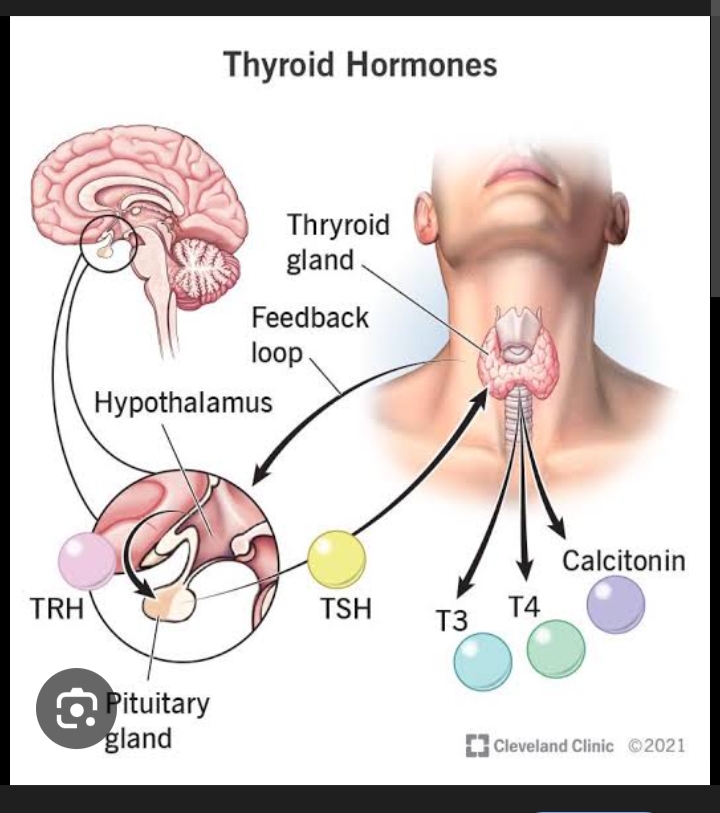
TSH stands for Thyroid Stimulating Hormone. It's a hormone produced by the pituitary gland that stimulates the thyroid gland to produce thyroid hormones, primarily T4 (thyroxine) and T3 (triiodothyronine). These hormones are crucial for regulating metabolism, heart rate, body temperature, and many other bodily functions.
Key points about TSH:
Production: The pituitary gland produces TSH.
Stimulation: TSH stimulates the thyroid gland to produce thyroid hormones.
Feedback mechanism: TSH levels are regulated by a feedback loop involving thyroid hormones. If thyroid hormone levels are low, TSH levels increase to stimulate the thyroid. If thyroid hormone levels are high, TSH levels decrease to slow down thyroid hormone production.
TSH test: A TSH test is a blood test that measures the amount of TSH in the blood. It's a common way to assess thyroid function.
Abnormal TSH levels:
High TSH: Usually indicates hypothyroidism (underactive thyroid) because the pituitary gland is trying to stimulate the thyroid to produce more hormones.
Low TSH: Usually indicates hyperthyroidism (overactive thyroid) because the pituitary gland is reducing its stimulation of the thyroid.
Normal range: The normal range for TSH levels is typically between 0.4 and 4.0 mIU/L. However, this can vary slightly depending on the lab and individual factors.
Key points about TSH:
Production: The pituitary gland produces TSH.
Stimulation: TSH stimulates the thyroid gland to produce thyroid hormones.
Feedback mechanism: TSH levels are regulated by a feedback loop involving thyroid hormones. If thyroid hormone levels are low, TSH levels increase to stimulate the thyroid. If thyroid hormone levels are high, TSH levels decrease to slow down thyroid hormone production.
TSH test: A TSH test is a blood test that measures the amount of TSH in the blood. It's a common way to assess thyroid function.
Abnormal TSH levels:
High TSH: Usually indicates hypothyroidism (underactive thyroid) because the pituitary gland is trying to stimulate the thyroid to produce more hormones.
Low TSH: Usually indicates hyperthyroidism (overactive thyroid) because the pituitary gland is reducing its stimulation of the thyroid.
Normal range: The normal range for TSH levels is typically between 0.4 and 4.0 mIU/L. However, this can vary slightly depending on the lab and individual factors.
Book Free Home Collection : 7775837228/8999989854
Email Id: nidanpathology331@gmail.com
Rupeenagar
Chakan |
Punawale
Wakad |
Pimpari |
Krushnanagar |
Ravet