

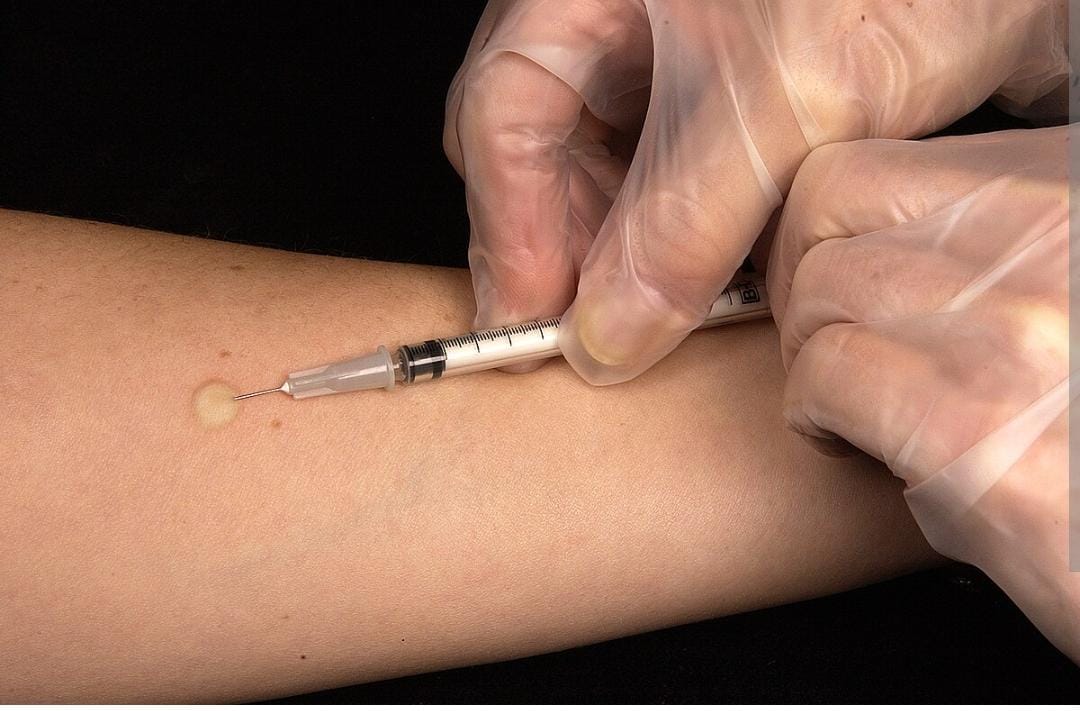
The Mantoux test, also known as the tuberculin skin test (TST), is a method used to detect if a person has been exposed to the bacteria that causes tuberculosis (TB). It involves injecting a small amount of tuberculin purified protein derivative (PPD) under the skin and observing the reaction at the injection site after 48 to 72 hours.
Here's a more detailed explanation:
Purpose:
The Mantoux test helps identify individuals who may have been exposed to Mycobacterium tuberculosis, the bacteria that causes TB. It's primarily used to screen for latent TB infection (LTBI), where the bacteria is present but inactive, or to assess the risk of active TB.
Procedure:
A small amount of PPD is injected into the skin, typically on the inner forearm. The injection creates a small bump (wheal) that should disappear shortly after.
Reading the results:
After 48 to 72 hours, a healthcare professional will examine the injection site for a reaction. The key indicator is the induration, which is the hardened, raised area at the injection site. Redness alone is not the determining factor; the induration needs to be measured.
Interpretation:
The size of the induration is measured in millimeters. A positive reaction (meaning exposure to TB bacteria) is indicated by a certain size of induration, which varies depending on the individual's risk factors and medical history. For example, a 10 mm or greater induration is generally considered positive in people with no known risk factors for TB.
Further action:
A positive Mantoux test doesn't automatically mean a person has active TB. Further tests, such as a chest X-ray or sputum test, may be needed to determine if the infection is active or latent.
Limitations:
The Mantoux test cannot differentiate between latent and active TB infection. It can also be affected by prior BCG vaccination or other medical conditions.
In Pimpri Chinchwad Pune
Exploring Truth...
NIDAN
Pathology Laboratory
ISO 9001:2015 Certified
Book Free Home Collection : 7775837228/8999989854
Email Id: nidanpathology331@gmail.com
Rupeenagar
Chakan |
Punawale
Wakad |
Pimpari |
Krushnanagar |
Ravet
Here's a more detailed explanation:
Purpose:
The Mantoux test helps identify individuals who may have been exposed to Mycobacterium tuberculosis, the bacteria that causes TB. It's primarily used to screen for latent TB infection (LTBI), where the bacteria is present but inactive, or to assess the risk of active TB.
Procedure:
A small amount of PPD is injected into the skin, typically on the inner forearm. The injection creates a small bump (wheal) that should disappear shortly after.
Reading the results:
After 48 to 72 hours, a healthcare professional will examine the injection site for a reaction. The key indicator is the induration, which is the hardened, raised area at the injection site. Redness alone is not the determining factor; the induration needs to be measured.
Interpretation:
The size of the induration is measured in millimeters. A positive reaction (meaning exposure to TB bacteria) is indicated by a certain size of induration, which varies depending on the individual's risk factors and medical history. For example, a 10 mm or greater induration is generally considered positive in people with no known risk factors for TB.
Further action:
A positive Mantoux test doesn't automatically mean a person has active TB. Further tests, such as a chest X-ray or sputum test, may be needed to determine if the infection is active or latent.
Limitations:
The Mantoux test cannot differentiate between latent and active TB infection. It can also be affected by prior BCG vaccination or other medical conditions.
In Pimpri Chinchwad Pune
Exploring Truth...
NIDAN
Pathology Laboratory
ISO 9001:2015 Certified
Book Free Home Collection : 7775837228/8999989854
Email Id: nidanpathology331@gmail.com
Rupeenagar
Chakan |
Punawale
Wakad |
Pimpari |
Krushnanagar |
Ravet